Grid-friendly charging and benefiting from reduced grid fees
Anyone who drives an electric car could already be charging more cheaply at home today. According to § 14a of the Energy Industry Act (EnWG), owners of private charging stations are entitled to reduced grid fees if they allow the grid operator to temporarily throttle the charging power when required.
While this is primarily intended for conventional wallboxes, mobile charging solutions could also benefit. By combining JUICE BOOSTER 2 and JUICE CHARGER easy, electric car drivers can already meet these requirements today without having to sacrifice their accustomed charging flexibility.
Why EV drivers should now look into § 14a EnWG
With the new regulation of §14a of the Energy Industry Act (EnWG), the legislator aims to prepare the electricity grids for the growing number of electric cars, heat pumps, and battery storage systems. The principle behind it is simple: those who allow the grid operator to temporarily reduce the charging power of their charging station in the event of impending grid bottlenecks will be financially rewarded.
The Federal Network Agency has defined clear framework conditions for this. Although charging power may be temporarily limited, a complete shutdown – as was previously the case with the ripple control signal for boilers – is not intended. A minimum power level always remains available. Thus, no one has to compromise on comfort, as the electric car remains usable at all times in everyday life.
What does this mean for mobile chargers?
Until now, the regulation has primarily focused on permanently installed wallboxes. With the advancing digitalization of electricity grids and the expansion of intelligent metering systems, the scope of application could also extend to mobile charging stations in the future. To keep pace with this development, it is already worthwhile today to design charging infrastructures in such a way that they can meet future requirements. Especially for homeowners and installation companies, the question of how mobile charging solutions like the JUICE BOOSTER 2 can be integrated into a controllable overall system becomes relevant.
With the JUICE CHARGER easy as a link, the JUICE BOOSTER 2 becomes load-sheddable
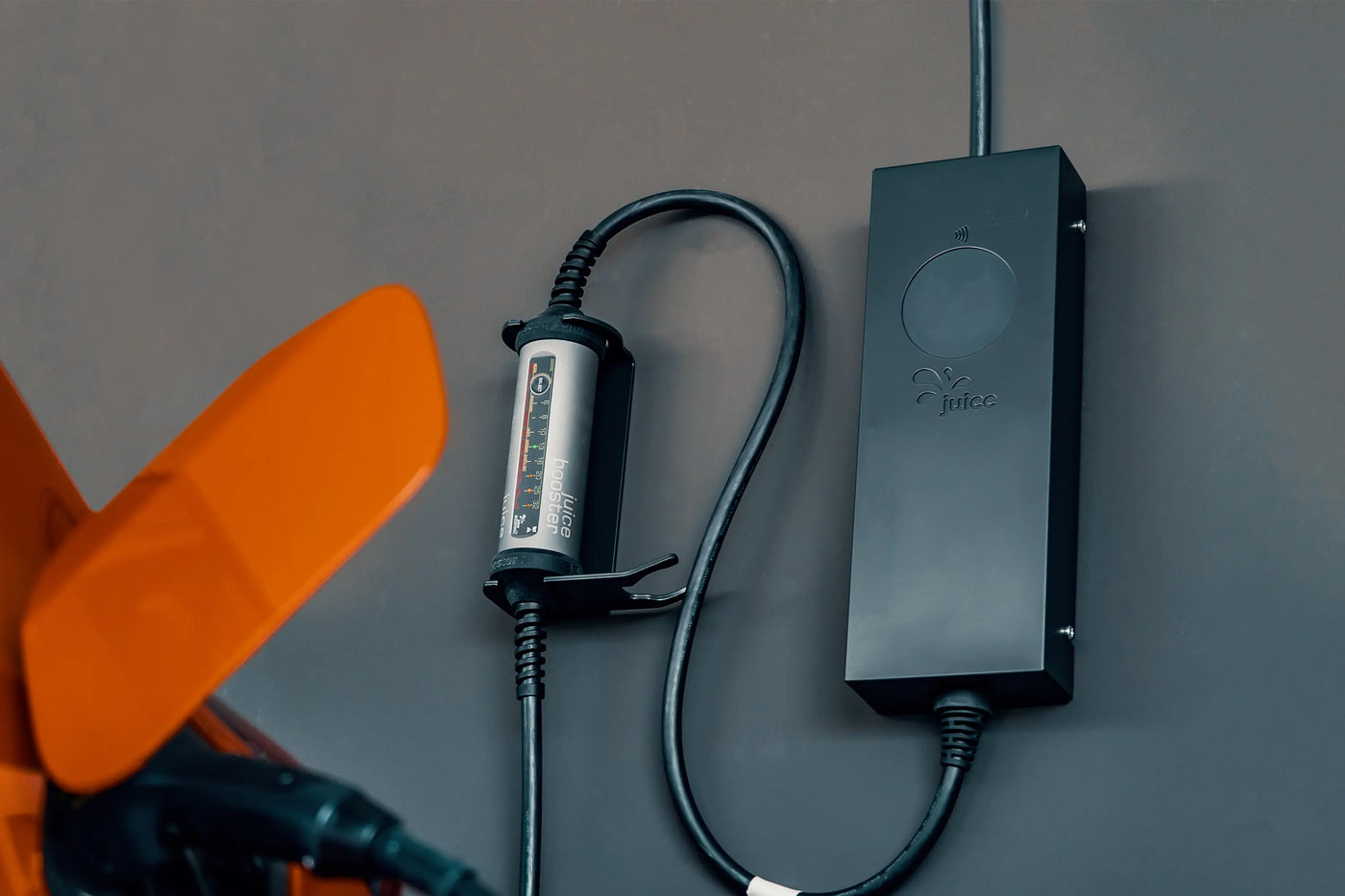
For the JUICE BOOSTER 2 to meet the requirements for implementation according to § 14a EnWG, a JUICE CHARGER easy is connected upstream. This creates a charging infrastructure that can be controlled in a grid-friendly manner when needed. Should there be a bottleneck situation in the electricity grid, the grid operator can temporarily reduce the charging power in accordance with legal requirements. In everyday life, this is usually barely noticeable: the vehicle continues to charge and the JUICE BOOSTER 2 remains flexible in use.
The JUICE CHARGER easy also features an RFID activation function, which allows charging processes to be specifically authorized. Especially in parking garages, underground car parks, and carports, this prevents unauthorized persons from using the charging station.
Up to approx. 150 Euros savings per year possible
In combination with the JUICE CHARGER easy, the charging infrastructure becomes fit for future regulatory requirements and at the same time creates the conditions for reduced grid fees. Depending on the grid area and tariff model, this results in potential savings of around 150 Euros per year. Especially with long-term use of an electric vehicle, these benefits can add up significantly over the years.

Practical tips for electricians
To ensure that the installation meets the requirements for grid-friendly control, the following settings must be made on the JUICE CHARGER easy:
Setting the maximum current
The rotary switch in the JUICE CHARGER easy housing must be set to a maximum of 20 A (position 5). In most applications, however, a maximum of 16 A per phase is permissible. This corresponds to position 4.
Reduction to 6 Amperes per phase
For power reduction to 6 A per phase, the potential-free contacts 3 and 4 must be short-circuited via an external relay. This allows the charging power to be reduced to the required level – 25% of the set current – if necessary, but at least to 6 A per phase.
§ 14a EnWG briefly explained
§ 14a EnWG regulates how grid operators in Germany may temporarily limit the power of larger electricity consumers to prevent overloads in the electricity grid. This also includes private charging facilities for electric vehicles.
In return for the possibility of a temporary power reduction, customers receive reduced grid fees, i.e. a discount on part of their electricity bill.
- The private wallbox can be classified as a controllable consumption device.
- Reduced grid fees are possible for this.
- The grid operator may temporarily reduce the charging power in rare grid bottleneck situations.
- Charging is throttled to a minimum power, not completely switched off.
- Smart meters will enable standardized digital control in the future.
What is Module 1?
Various models, known as modules, are available for reducing grid fees. They differ in the type of calculation and the amount of the possible discount.
Module 1 is the simplest and most widely used variant. Operators of a controllable charging facility receive a flat-rate reduction in grid fees of typically around 110 to 190 Euros per year.
New installations commissioned since January 1, 2024, must already be controllable. Older installations are subject to transitional periods until the end of 2028. Those who wish to benefit from Module 1 earlier must prove that the charging facility can be controlled by the grid operator.
In combination with the JUICE CHARGER easy, the JUICE BOOSTER 2 can meet the requirements for participation in the § 14a-EnWG-Module 1 and thus benefit from reduced grid fees.
JUICE BOOSTER 2
The JUICE BOOSTER 2 is Juice's mobile 3-in-1 charging solution. It is a wallbox, mobile charging station, and Mode 3 charging cable all in one. Thanks to its robust construction and numerous adapters, it can be safely charged almost anywhere.
JUICE CHARGER easy
The JUICE CHARGER easy turns the JUICE BOOSTER 2 into a permanently installed wallbox that can be controlled by the energy supplier and operated in a load-sheddable manner. This creates the technical basis for grid-friendly operation according to § 14a EnWG.
Read more here
- Standards are not an annoying obligation – they are the basis for safe and trouble-free operation
https://juice.world/en/blogs/news-hub/charge-at-any-socket-but-safely - What is bidirectional charging?
https://juice.world/en/blogs/news-hub/what-is-bidirectional-charging - Does the home wallbox for electric company cars have to be "eichrechtskonform" (calibrated according to German metrology law)?
https://juice.world/en/blogs/news-hub/does-a-wallbox-for-company-cars-have-to-comply-with-legal-metrology-regulations - Can I charge my electric car with 6 amps of solar power?
https://juice.world/en/blogs/news-hub/can-i-charge-my-e-car-with-6-amps-of-solar-power - Is an 11 kW wallbox subject to approval?
https://juice.world/en/blogs/news-hub/ist-eine-11-kw-wallbox-genehmigungspflichtig