The daily commute on four wheels
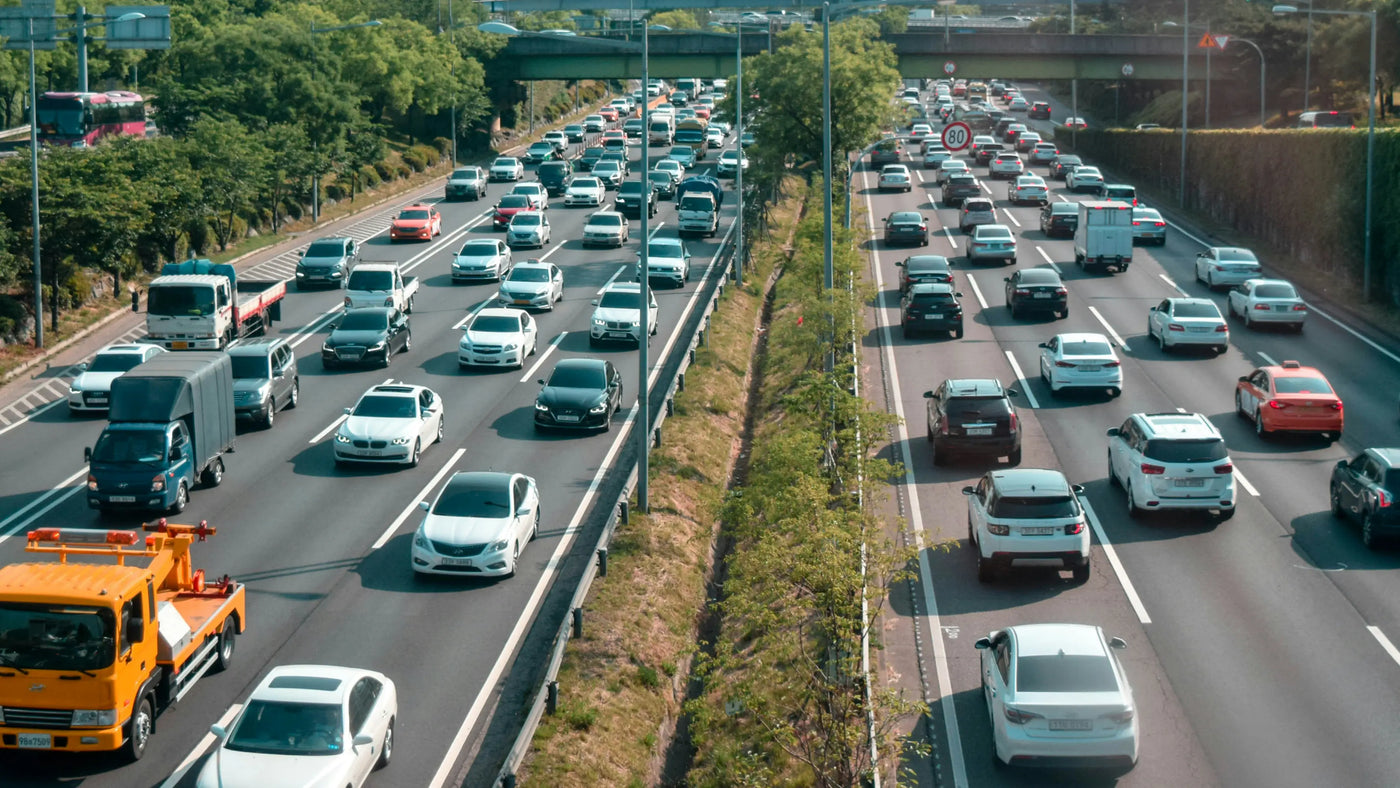
The majority of commuter traffic in Germany, Austria, and Switzerland takes place on the roads. Electric cars offer a decisive advantage: they not only operate with zero local emissions, but also incur significantly lower operating costs.
The majority of commuters in the DACH region (Germany, Austria, and Switzerland) use their own car: around 65% of Germans commute this way, compared to 54% in Austria and about 50% in Switzerland. In Germany, many commutes are short – almost half are under 10 km. In Switzerland, the average commute is about 14 km and in Austria around 27 km. Overall, commuters travel between 30 and 50 km by car for their round trip.
Save electricity instead of wasting fuel
Electric cars are not only convincing due to their lower operating costs, but also because of their environmental footprint: they emit neither CO₂ nor pollutants while driving. Studies show that over their entire life cycle, electric cars produce around 53% less greenhouse gas than gasoline cars and even 59% less than diesel cars.
At the same time, energy costs are significantly lower. Modern electric cars consume approximately 15–16 kWh per 100 km with moderate driving. With a household electricity price of around CHF 0.277/kWh (2026) or EUR 0.30/kWh, this equates to CHF/EUR 4–5 per 100 km. By comparison, an average gasoline car with a fuel consumption of 7.5 l/100 km, at fuel prices of CHF 1.65 or EUR 1.80 per liter (as of October 2025), would cost approximately CHF 12–13 or EUR 13–15 over the same distance. For a daily commute of around 30 km, this results in costs of approximately CHF/EUR 4–5 for a combustion engine car – and only about CHF/EUR 1–2 for an electric car.
Cost comparison: Petrol versus electricity
The figures speak for themselves: According to an analysis by E.ON, a commuter with an electric car already saves almost 50% on energy costs by charging at home compared to a gasoline-powered car – and with smart off-peak electricity tariffs, even up to 70%. Typically, the vehicle is charged when it's parked anyway – at home or in the company parking lot. Around 82% of all electric car drivers use a home wallbox.
Here's a calculation example: Roughly one-third of employees in Germany commute 10–25 km to work daily – that's 20–50 km per day. For a combustion engine vehicle, the annual fuel costs amount to approximately EUR 1,037. An electric car, using the standard electricity tariff (EUR 0.33/kWh), incurs costs of only around EUR 559 over the same period. With a night-time electricity tariff controlled by the energy provider, the costs even drop to around EUR 300 per year – a saving of approximately EUR 480 or EUR 735 per year compared to a combustion engine vehicle.
Calculation example

- Home charging (night-time electricity) : approx. EUR 300 → Savings: EUR 735
- Home charging (standard rate): approx. EUR 559 instead of EUR 1,037 → Savings: EUR 478
- Public AC charging station: approximately EUR 914 → Savings: approximately EUR120
- Fast charging (DC): without a special tariff, it tends to be more expensive than petrol (at 0.75 EUR/kWh, approximately 1,270 EUR/year)
Ideally, a commuter using an electric car can save up to 70% compared to driving a combustion engine vehicle. Without night-time pricing, the savings can exceed 40–50%. Even the comparatively more expensive public AC charging remains cheaper than gasoline. Those who benefit the most are those who can charge for free – whether at their workplace or using their own solar panels.
Charge intelligently, save more
Smart electricity tariffs are gradually emerging, enabling additional savings. Some energy providers offer night-time tariffs where charging automatically takes place at the cheapest time – usually between midnight and 6 a.m. An algorithm controls the charging process based on the lower electricity prices on the exchange at night, ensuring that the vehicle is fully charged and ready to go in the morning. This increases savings without sacrificing convenience. Private smart charging solutions and green electricity contracts also allow for these fully automated charging processes.
Commuting with an electric car is worthwhile
- Electric cars score points with environmental and cost advantages and are therefore ideally suited for the daily commute.
- For commuters, switching from combustion engine vehicles hardly changes anything – except that they no longer have to make a detour to the petrol station.
- On the same commute, the electricity in the battery often costs less than half the price of the fuel in the tank.
- Using a home charging station and off-peak electricity can save you several hundred euros per year.
- The JUICE CHARGER me 3 and the JUICE BOOSTER 3 air offer two convenient, precise measuring charging solutions for everyday commuting.
Smart charging with Juice – at home and on the go
For anyone looking to further optimize their commuting costs, smart charging hardware is worth considering. The JUICE CHARGER me 3 is an elegant, compact wallbox with an integrated, MID-compliant meter, ideally suited for daily home charging. All charging sessions are recorded and automatically broken down in the clear dashboard – including energy consumption, costs, and time allocation. Day and night tariffs are clearly displayed, allowing for optimal analysis of individual charging behavior.
For those who want to remain flexible, the JUICE BOOSTER 3 air is the ideal choice – a mobile wallbox with a precise, digital electricity meter. It enables safe charging at virtually any available socket and, with the j+ pilot app, provides a complete overview of all charging processes. Individual electricity tariffs can also be entered, so you always know exactly what each kilowatt-hour costs – whether you're on the go, at your vacation home, or in the company parking lot.
Read more here
- Mobile or stationary wallbox: Which one is suitable for everyday commuting?
https://juice.world/en/blogs/news-hub/on-the-go-or-at-home-which-is-better-a-mobile-or-stationary-wallbox
Find out whether a permanently installed wallbox or a flexible mobile solution is a better fit for your daily charging habits. - Electromobility in Switzerland: Why home charging is a game changer
https://juice.world/en/blogs/news-hub/electromobility-in-switzerland
How charging at home simplifies the everyday lives of Swiss commuters – and why exactly this is driving the electric car boom. - Does a wallbox for company cars have to comply with calibration law?
https://juice.world/en/blogs/news-hub/does-a-wallbox-for-company-cars-have-to-comply-with-legal-metrology-regulations
How to properly account for commuting and home charging costs, and why a MID-compliant meter is sufficient for company cars. - Fleet loading without detours
https://juice.world/en/blogs/news-hub/fleet-management-rethought-charging-without-charging-cards-and-extra-trips
How Juice's modern charging solution eliminates extra trips and significantly simplifies daily charging for employees. - Home charging can be this convenient for commuters today
https://juice.world/en/blogs/news-hub/juice-charger-me-3-new-functions-thanks-to-its-own-dashboard-and-app-access
The JUICE CHARGER me 3 dashboard shows all charging processes and costs in detail – perfect for all commuters who want to charge efficiently and smartly.